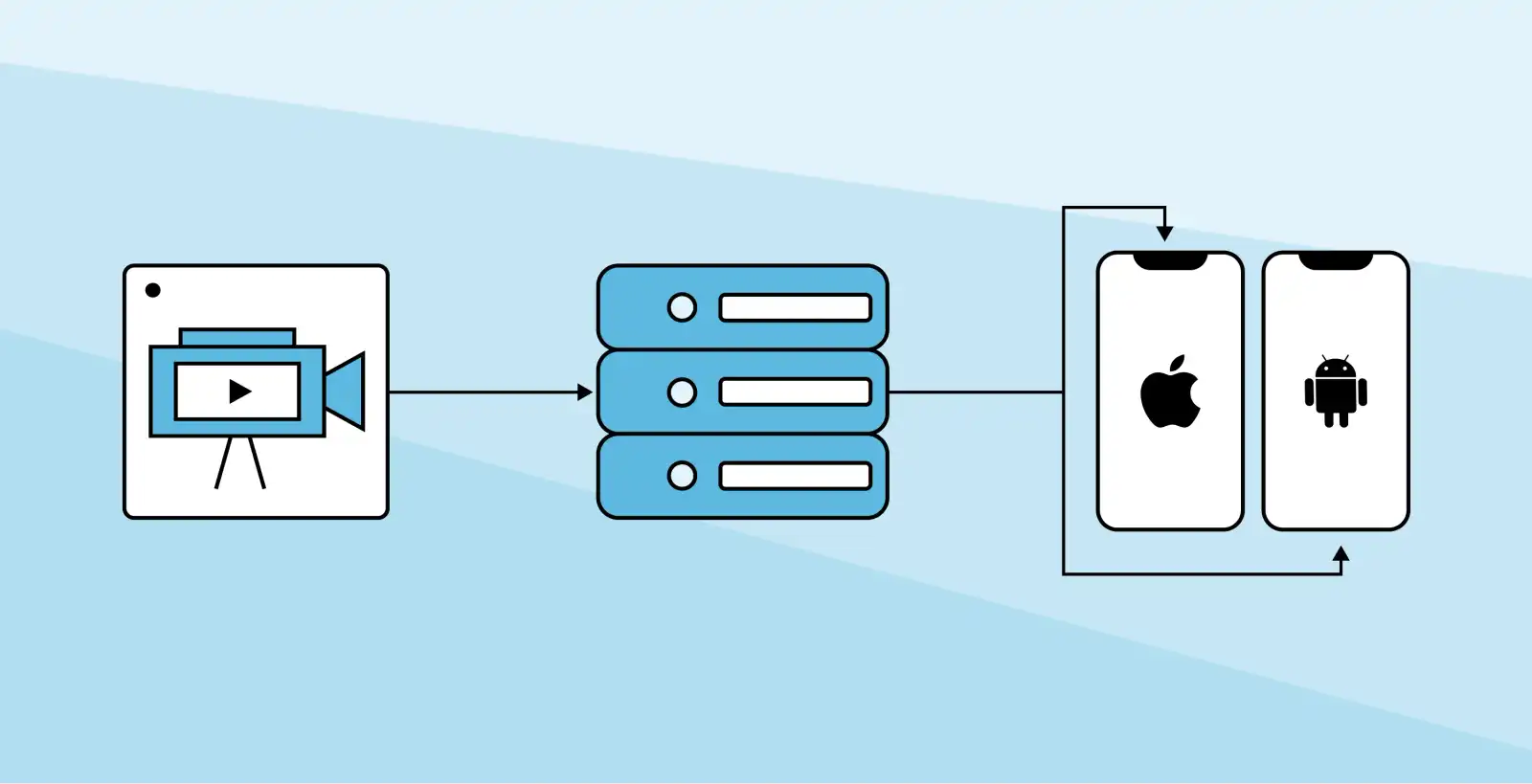
From now on Fishjam supports MoQ protocol!Read more

Media over QUIC, ready to swim.

Fishjam runs a production MoQ relay, so you can broadcast to large audiences with sub-second latency.

Two verbs: publish and subscribe

MoQ is a publish/subscribe protocol. One client publishes named tracks, another subscribes to the ones it wants, and the Fishjam relay between them carries each track to everyone who asked for it.

Publish

Send each track once

A publisher announces a broadcast under a path and sends its tracks to the relay. It sends one copy of each, whether ten people are watching or ten thousand.

  • Camera, microphone and screen, or your own data: chat messages, game controls, telemetry.
  • From the browser with @moq/publish, from iOS and Android with MoQKit.
  • What you send to the relay is free.

publish.ts@moq/publish

// publishUrl comes from your backendconst connection = await Moq.Connection.connect(  new URL(publishUrl),);const broadcast = new Publish.Broadcast({  connection,  name: Moq.Path.from(PUBLISHER_PATH),  enabled: true,  video: {    source: camera.source,    hd: { enabled: true },  },  audio: { enabled: true, source: microphone.source },});

MoQ web publishing tutorial →

Subscribe

Take only what you need

A subscriber watches a path, sees the broadcasts announced there and asks for the tracks it wants. A track it never asks for is never sent to it.

  • Picks tracks from the broadcast's catalog: the picture, a language, sound on its own.
  • Keeps its own playback clock, from a 100 ms buffer up.
  • In the browser with @moq/watch, natively with MoQKit in Swift and Kotlin.

watch.ts@moq/watch

// subscribeUrl comes from your backendconst connection = await Moq.Connection.connect(  new URL(subscribeUrl),);const broadcast = new Watch.Broadcast({  connection,  name: Moq.Path.from(SUBSCRIBER_PATH),  enabled: true,});// decodes and paints onto a <canvas>const backend = new Watch.MultiBackend({  element: canvas, broadcast, paused: false,});

MoQ web subscribing tutorial →

Both

One client can do both

A service that turns one track into another is one more client of the relay. It subscribes to what it needs and publishes the result under a path of its own: a translation, a transcript, a moderation verdict. The translator below is one →

Viewers subscribe to tracks, not to a stream

A broadcast on the relay is a set of named tracks. Each client asks for the ones it wants and keeps its own playback clock, so one publish serves all four of these at once.

On the relay

brave-otter published by the streamer

  • video camera
  • audio original voice

brave-otter/google/translation published by the translator

  • es Spanish voice
  • es/transcript.json Spanish captions
  • ja Japanese voice

80+ languages on the menu. None of them runs until someone subscribes.

Watching live

Takes the picture and the original sound and plays them from a 100 ms buffer. The buffer is this player's own setting: the publisher doesn't know about it and no other viewer is affected.

Subscribes to
videoaudio
Buffer
100 ms
Delivered
about 1.2 GB an hour

Watching in Spanish

Takes the Spanish voice in place of the original, plus captions. The model has to hear a sentence before it can say it, which takes about 2.5 seconds, so this player holds the picture for as long and the voice lands on the right frame.

Subscribes to
videoeses/transcript.json
Buffer
about 2.5 s
Delivered
about 1.2 GB an hour

Listening only

Asks for the sound and nothing else. The relay never sends this client the video, so the video is neither decoded nor billed.

Subscribes to
audio
Buffer
100 ms
Delivered
about 45 MB an hour

Translating

One more client of the relay. It listens to the original sound, feeds it to a live translation model and publishes the Spanish voice back. It starts when the first viewer subscribes to es and stops five seconds after the last one leaves. A thousand Spanish viewers share that one session.

Subscribes to
audio
Publishes
eses/transcript.json
Delivered
about 45 MB an hour; what it publishes is free

The translation tracks are how translate.fishjam.io works, and the write-up has the details. MoQ is billed at $0.04 per GB delivered; inbound traffic is free. Figures assume 2.5 Mbps video and 0.1 Mbps audio.

One stream, 80 languages

Speak once, and every viewer hears you in their own language, live.

Choose how you want to build

Free tier

Start with Fishjam

Try every Fishjam feature with 5,000 participant-minutes a month for free.

Start for free
Go to production

Build with Fishjam

Pay as you go once your app takes off, with pricing that doesn't punish your growth.

See pricing
With our engineers

Ship with Fishjam

Get hands-on help with your integration from the engineers who build Fishjam.

Talk to our team

Ready to build?